Star flares suppressed by strong magnetic fields — lab experiment finally explains why
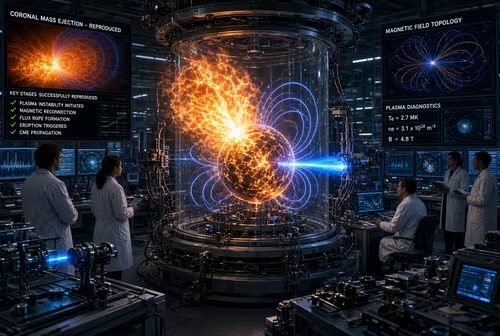
Physicists have for the first time recreated the key stages of a coronal mass ejection — a massive cloud of plasma ejected from a star's surface — in a laboratory setting. The experiment helped solve a long-standing puzzle: why such events are so rarely detected on other stars, and why their power is often unexpectedly low.
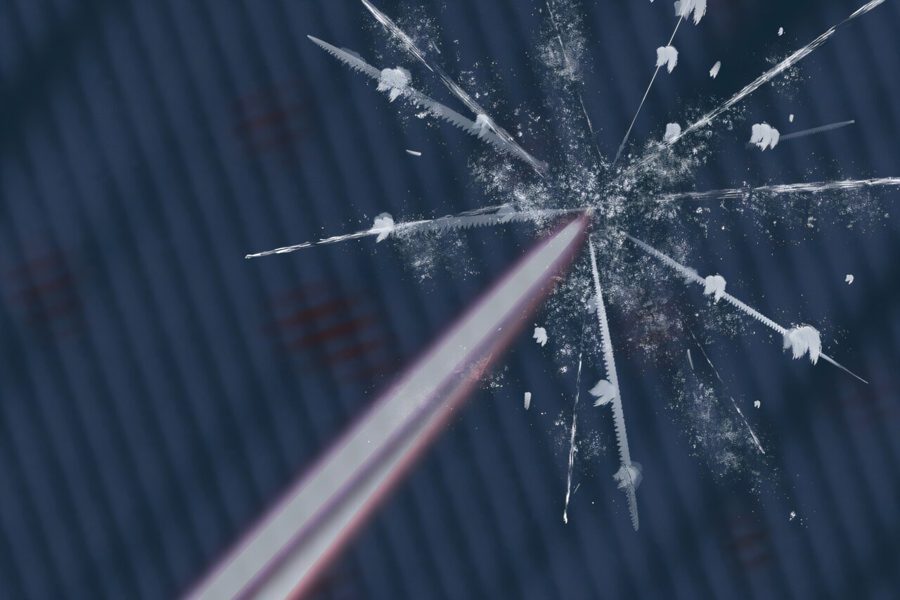
The researchers used the powerful laser pulses of the ELFIE facility in France. The laser was directed at a Teflon film placed in a strong magnetic field, producing a plasma cloud whose properties closely resembled those of a natural coronal ejection.
The critical finding concerned how the plasma's behavior depended on the magnetic field's strength. A weak magnetic field did little to prevent the plasma from escaping the surface. However, when the field strength reached around 30 T, the situation changed dramatically. The magnetic field destabilized the ejection and literally tore it into fragments, preventing the plasma cloud from fully leaving the star.
Computer modeling revealed the underlying physical mechanism: a helical instability. Under its influence, the plasma flows begin to twist and, as a result, fall back onto the star. This means that strong magnetic fields can suppress coronal ejections, explaining their rarity and the unusually low power of such events observed on many neighboring stars.