How a Rubidium Frequency Standard Works: A Step-by-Step Breakdown
Rubidium frequency standards are used wherever an extremely accurate time or frequency reference is needed, and video blogger has offered a detailed look at what goes on inside such a device. Most of the underlying principles also apply to cesium standards.
The explanation starts with the periodic table. Rubidium and cesium are both alkali metals, each with a single electron in the outermost shell. Rubidium has 37 electrons, with the outer one held relatively loosely. Naturally occurring rubidium consists mainly of two isotopes, rubidium-85 and rubidium-87, which share the same number of protons and electrons but differ in neutron count.
A typical rubidium standard contains three gas cells holding a small amount of rubidium. A discharge lamp based on rubidium-87, excited by radio-frequency energy, emits light at very specific wavelengths. The RF field pushes rubidium atoms into higher electronic states, and when their electrons fall back to lower-energy levels, the atoms release photons.
That light passes through a filter cell containing rubidium-85. The filter selectively absorbs part of the lamp's spectrum, leaving light that optically pumps rubidium-87 atoms in the second resonance cell into one of two closely spaced hyperfine states of the ground state.
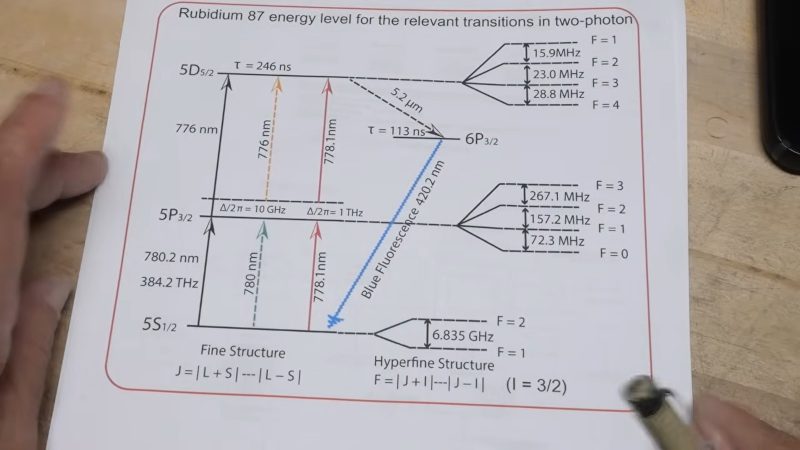
These two states differ due to the interaction between the magnetic moments of the outer electron and the rubidium-87 nucleus. Their energy separation corresponds to a microwave frequency of about 6.835 GHz.
The resonance cell is illuminated by the filtered light while also being exposed to microwaves from a local oscillator. When the microwave frequency exactly matches the rubidium-87 hyperfine transition, atoms move between the two ground-state hyperfine levels. This alters how strongly the cell absorbs the optical pumping light, producing a detectable dip in the light reaching a photodetector.
Electronics then lock the microwave oscillator to the center of that absorption dip using a feedback technique somewhat analogous to a phase-locked loop. Once locked, the oscillator is referenced to an atomic transition rather than to the dimensions or mechanical properties of a crystal, yielding an extremely stable frequency standard.
Cesium clocks are more accurate than rubidium ones, and optical clocks surpass even those. Still, rubidium standards remain popular due to their balance of accuracy, cost, and compactness.