Physicists claim first proof of glueball, a particle made of pure strong force
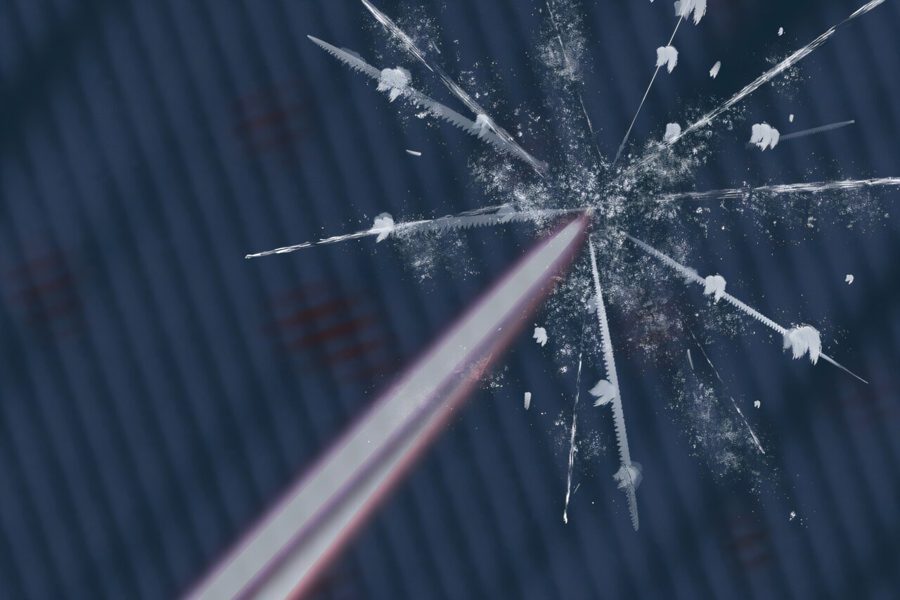
Scientists have announced the strongest evidence yet for the existence of the glueball, a hypothetical particle made almost entirely of gluons, the carriers of the strong nuclear force. The results were presented last week at the International Conference on High Energy Physics (ICHEP), with a preprint posted on arXiv the previous month, based on experiments at a collider in Beijing.
In the experiment, particles labeled X(2370) were produced by smashing electrons into positrons at high energies. Their combined properties match what theorists predicted for a glueball. Colin Morningstar, a particle physicist at Carnegie Mellon University who was not involved in the work, called the result "an experimental triumph" and said it is the strongest indication yet that particles dominated by a glueball component can exist in nature.
The search for the glueball has spanned more than half a century. Unlike quarks, gluons do not exist as free particles and are always bound inside hadrons, yet theory allows bound states made of gluons alone — and that is exactly what a glueball would be. If the interpretation holds, one of the strangest particles predicted by modern theory has finally found experimental confirmation.
The finding adds to a broader picture: earlier this year, another group reported a possible glueball sighting in data from the Large Hadron Collider, though those results were considered less definitive. The new discovery, made at China's BES III collider, looks more robust because the mass spectrum and quantum numbers of X(2370) match calculations for the lightest glueball precisely.