Medieval trebuchet hurls projectile past sound barrier at 1,249 km/h
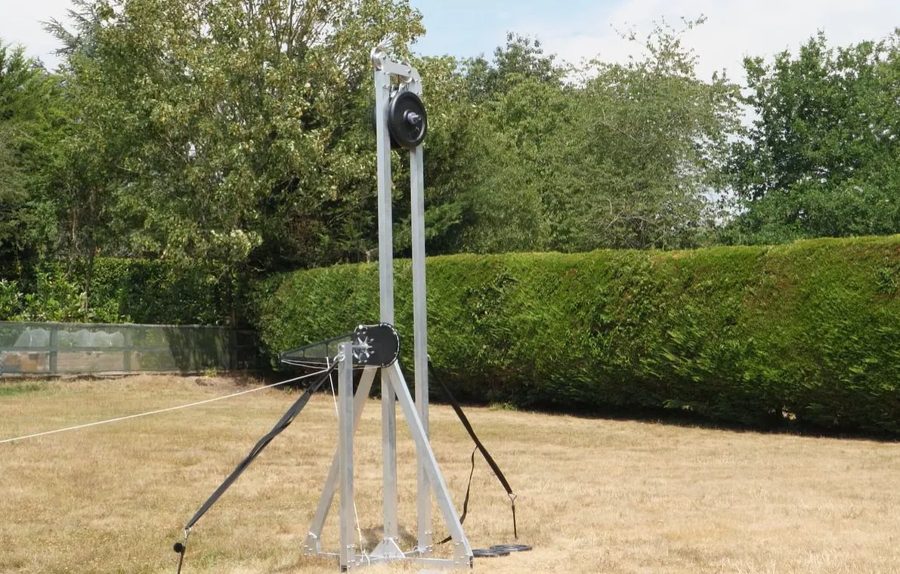
Engineer and YouTuber Tom Stanton upgraded a classic trebuchet and achieved what medieval builders never managed: his machine accelerated a projectile past the speed of sound. In the final test, a four-gram payload left the sling at 346.4 meters per second, or 1,249 km/h, breaking the sound barrier with an audible snap.
The design relies on two key departures from a traditional trebuchet. Instead of attaching the projectile directly to the arm, the rope was wound around the axle, forcing the payload to make extra rotations and gain velocity. The second improvement is a gearing system that uses the energy of the falling counterweight more efficiently.
The tricky part was timing: the arm needed several rotations to spin up, so releasing the projectile had to be controlled within a 0.0025-second window. Stanton solved this with a low-tech but effective mechanism. The arm is attached to a drum with the rope wound around it, and once enough rope has unwound from the counterweight, a latch inside the drum releases the projectile.
A first test with a 10 kg counterweight produced a velocity of 528 km/h, a decent start but also a clear sign that the arm was not aerodynamic. After redesigning the entire trebuchet, the same counterweight pushed the projectile to 634 km/h. Next, Stanton ramped up to the full 40 kg, which theoretically should have reached supersonic speeds.
The first attempt with the heavier weight fell short at 1,152 km/h, just below the sound barrier at 1,235 km/h, with 39% system efficiency and some components visibly breaking apart. After further redesigns and switching to a lighter four-gram projectile, the 40 kg counterweight spun the arm at 2,342 rpm. The projectile left the sling at 346.4 m/s, or 1,249 km/h, breaking the sound barrier with an audible crack.
Even though the era of trebuchets in warfare is long gone, they remain fascinating physics demonstrations, and this project is a perfect example.