The 1954 Parametron Computer: No Tubes, Relays, or Transistors Needed
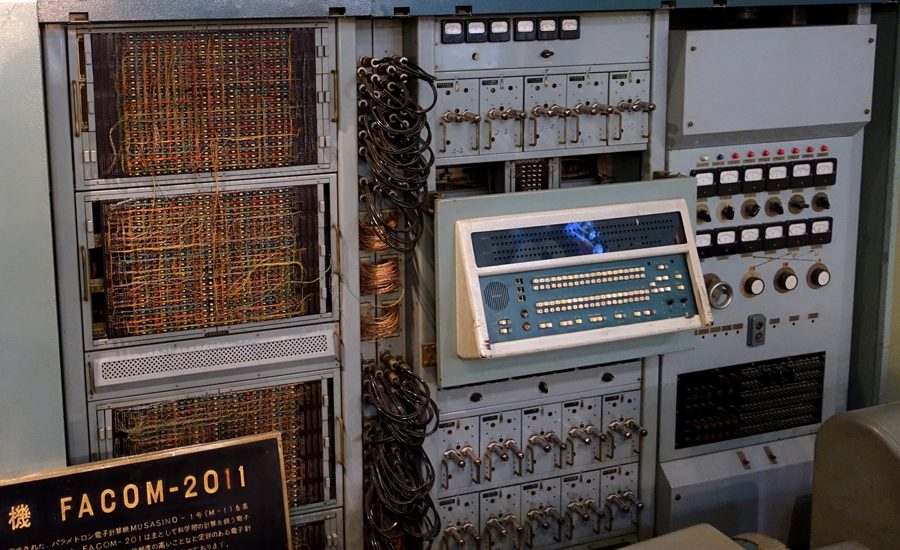
In 1954, Japanese engineer Eiichi Goto introduced the parametron — a resonant circuit built around a ferrite core and a capacitor that could store a bit as one of two oscillation phases. This device made it possible to build digital machines without conventional vacuum tubes, relays, or transistors, offering an unexpected approach in the early era of computing.
The parametron works as a parametric oscillator. A tuned circuit is set to a certain frequency, and its reactance is varied at twice that frequency. As a result, the circuit oscillates at half the pump frequency, and it has two equally stable states separated by 180 degrees of phase. One phase represents binary 0, the other binary 1. Unlike typical logic levels based on voltage, the state here is determined purely by the phase of the alternating current waveform.
To create a logic gate, several preceding parametrons are weakly coupled into the next one. When that next stage is excited, the incoming signals provide a tiny initial oscillation, which quickly grows to full amplitude due to the regenerative effect. With three inputs, signals of one phase reinforce each other while opposite-phase signals cancel out, so the new parametron naturally settles into the phase held by the majority of its inputs. Thus, a three-input parametron inherently acts as a majority gate.
If one input is permanently tied to 0 or 1, the same circuit becomes an AND or OR gate. Inversion is achieved by reversing the polarity of a coupling transformer. In practical machines, groups of parametrons were driven by staggered clock phases so that the result of one stage was established before the next stage began oscillating. A chain of three parametrons forms a basic SR flip-flop, and Goto's 1959 paper describes more complex circuits, including a parity checker.
The main drawback was speed. Even a high-speed parametron topped out at about 6 MHz, and the clock frequency of computers built with them was much lower. Still, parametrons found use in Japanese machines of that era, including the PC-1 computer, and remained relevant until transistor circuits became widespread. Goto's invention demonstrated an alternative path to digital computing, where a bit is encoded not by voltage but by the phase of oscillations.