Kimi K3's open weights rival GPT-5.6 and Fable 5, but need 1.56 TB of storage
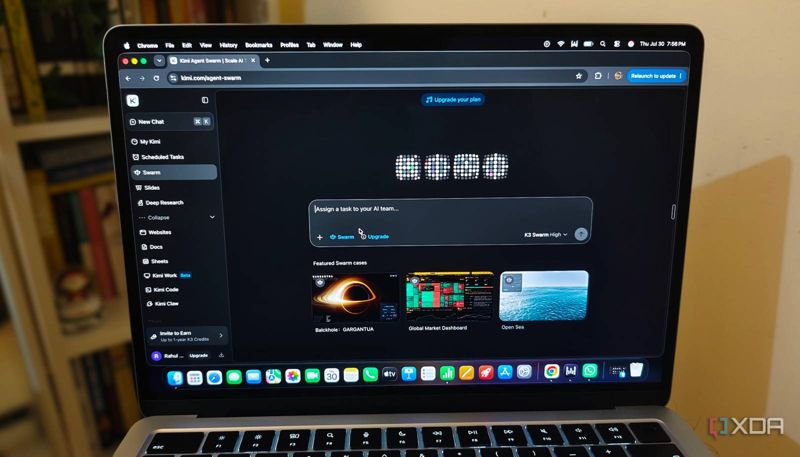
Moonshot has released the open-weight AI model Kimi K3, which can compete with closed-source flagships from leading labs. This marks the first time an open model has matched the performance of Anthropic's Fable 5 and OpenAI's GPT-5.6 Sol, an unexpected breakthrough for the open-weight ecosystem.
The full version of the model with 2.8 trillion parameters is now available on Hugging Face. The download is roughly 1.56 TB and spans 96 files, making self-hosting nearly impossible for average users. Moonshot has already compressed the weights using the low-precision MXFP4 scheme, so further optimization will not make the model fit on a gaming PC.
Kimi K3 is built on a Mixture-of-Experts architecture: it has 896 experts but activates only 16 per request, using about 104 billion of its 2.8 trillion parameters. This cuts the computing power needed to generate responses, but the full set of weights must remain accessible, so the model cannot be treated as a regular 104-billion-parameter system.
For comparison, Qwen3.5 and Llama 4 Maverick each have around 400 billion parameters, making K3 nearly seven times larger. Google's largest Gemma 4 model has just 31 billion parameters, with smaller versions running on laptops and even smartphones. The biggest Qwen and Llama models already demand serious hardware, but K3 belongs in a completely different category. It is technically available for anyone to download, but in practice it is built for data centers and well-funded AI labs.
The Kimi K3 license permits downloading, deploying, modifying, fine-tuning, and creating derivative models, as well as redistribution and commercial use. However, additional restrictions apply to model-as-a-service businesses generating more than $20 million in revenue, though the full terms are not disclosed.
This release signals that open models are no longer inherently behind. Major labs like OpenAI and Anthropic release only closed systems, backed by billions of investor dollars. Open-weight projects have traditionally lagged due to limited resources, but Kimi K3 shows the gap is narrowing and local AI is becoming an increasingly serious tool.