Three photons instead of two: physicists improve quantum computer test by 20%
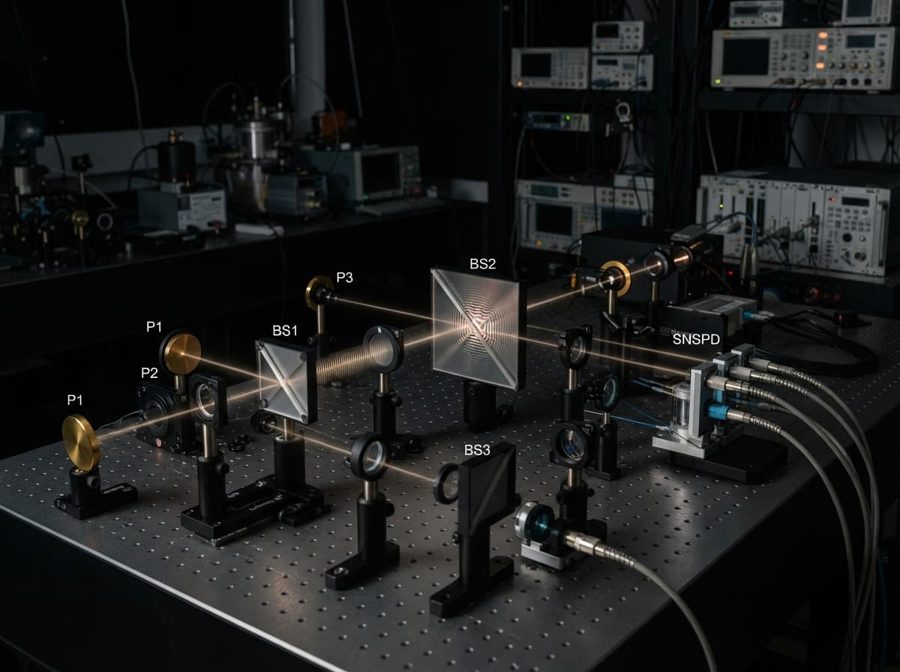
Physicists at the University of Twente in the Netherlands have improved the standard method for verifying the identity of photons used in quantum technologies. Instead of the traditional setup where two photons are compared simultaneously, they achieved interference of three particles at once. The results were published in Physical Review Letters.
For photonic quantum computing, it is critical that the photons used are as identical as possible. Since 1987, the Hong-Ou-Mandel (HOM) experiment has been the standard test for this: two photons are directed at a beam splitter, and if they are indistinguishable in their parameters, quantum interference causes them to exit the splitter together.
However, this approach becomes inefficient as systems scale. To check 10 photons, 45 separate pairs must be tested, each requiring thousands of measurement repetitions due to the probabilistic nature of quantum experiments. This dramatically increases the time and resources needed for calibration.
The new three-photon interference scheme extracts more information from each measurement. It reduces the number of required repetitions by nearly 20% to achieve the same accuracy. Importantly, the method remains functional even when some photons are lost — a critical advantage for real-world applications where losses are inevitable.
The researchers demonstrated that the three-photon test provides a more comprehensive characterization of photon similarity. While the standard HOM experiment only checks pairwise indistinguishability, the new approach captures higher-order correlations that are essential for multi-photon quantum operations.
This development could accelerate the creation of scalable photonic quantum computers by lowering the measurement requirements and improving the reliability of quantum state verification. The technique is particularly promising for integrated photonic platforms, where maintaining photon identity across many channels is a major challenge.