Proton’s baryon number may live in a gluon knot, not in quarks — STAR finds evidence
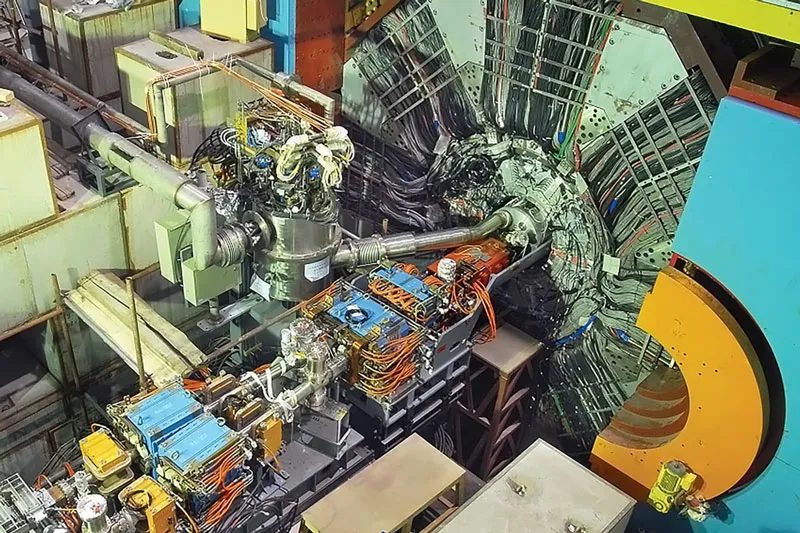
The STAR collaboration at the Relativistic Heavy Ion Collider (RHIC) at Brookhaven National Laboratory has obtained experimental evidence that the baryon number of a proton may be carried not by three valence quarks but by a special Y-shaped configuration of gluon fields — the so-called baryon junction. The findings were published in the journal Science.
In the standard textbook picture, a proton consists of three quarks, each carrying one-third of the baryon number — a fundamental quantum property that distinguishes matter from antimatter. Inside a real proton, however, besides the three valence quarks, there is a constantly fluctuating sea of gluons and quark-antiquark pairs. Until now, no experiment had pinpointed where exactly the baryon number resides.
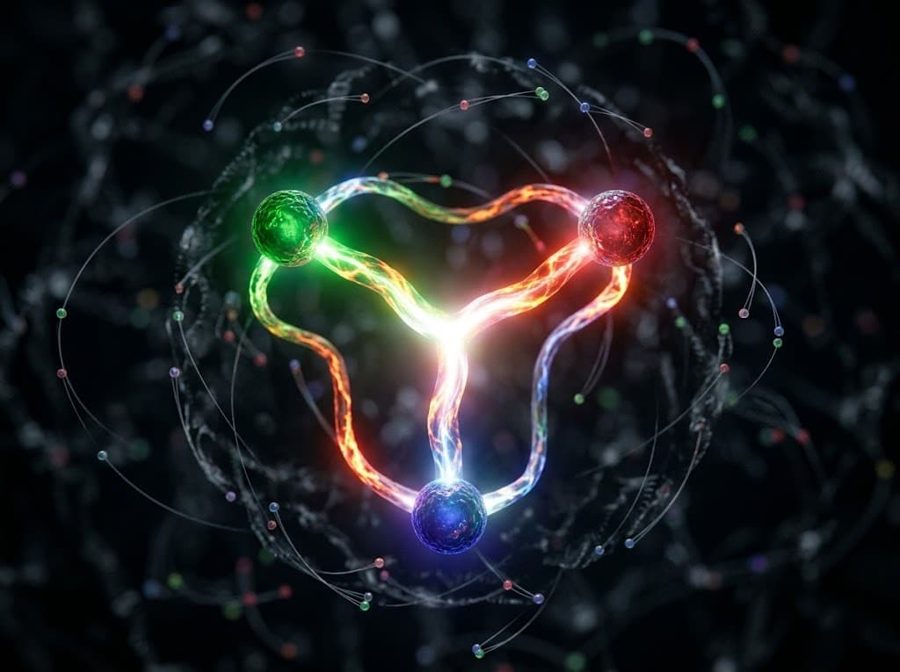
The idea of a gluon junction was first proposed in the 1970s and was further developed in 1996 as a possible mechanism for baryon number transport in high-energy collisions. According to this model, three gluon strings emanating from the quarks meet at a single point, forming a Y-shaped junction that itself carries the baryon number. In extreme collision conditions, this junction can "stop" and give rise to new baryons, while the fast-moving valence quarks fly forward.
The STAR team did not look inside a single proton. Instead, they analyzed data from collisions of gold and ruthenium nuclei, and in a separate experiment, ruthenium with ruthenium and zirconium with zirconium. By comparing the distribution of collision products, the scientists tracked the transport of baryon number over large distances along the collision axis. If the classic three-quark model were correct, the baryon number should have remained near the collision point or been carried away by fast quarks, the theory explains.
The measurements showed that antiprotons and antineutrons produced in the central collision region have an excess of kinetic energy compared to what the classical model would predict. This suggests that baryon number can be transported over long distances through gluon junctions rather than by quarks. The detected signal exceeds random fluctuations by 6.5 standard deviations, a level widely considered sufficient for a discovery claim.
If the model is confirmed, it will require a revision of the fundamental understanding of proton and neutron structure, as well as how baryon number is conserved under extreme conditions — including the early universe and the interiors of neutron stars. The STAR collaboration plans to conduct collisions with oxygen nuclei to test the new mechanism on lighter nuclei.