China's new accelerator caught a 40-year-missing isotope in just 10 days
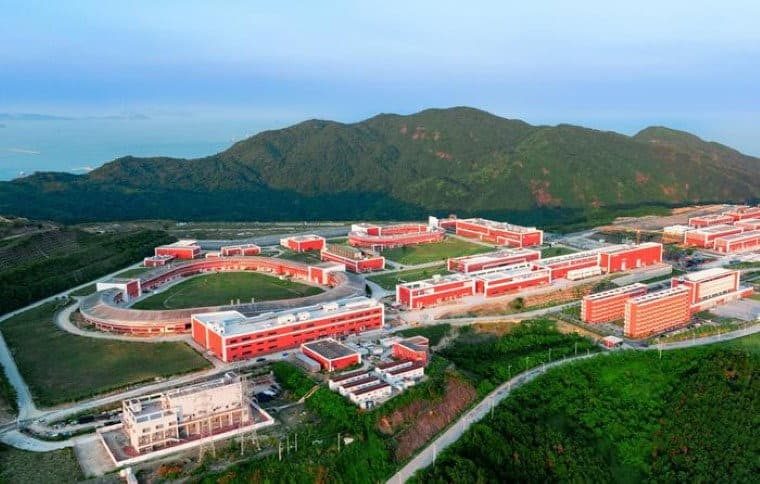
China's new heavy-ion accelerator facility HIAF has detected an extremely rare isotope, hafnium-153, just ten days after its first test runs began. An international team of physicists recorded 10 nuclei of this nuclide in the SRing spectrometer ring, marking the first reliable observation of an isotope that had eluded researchers since the 1980s.
Hafnium-153, consisting of 72 protons and 81 neutrons, had spent decades on the list of "predicted but undiscovered" nuclides. The only previous claim of its observation, made in 2000, was never confirmed by a peer-reviewed publication. Now this gap has been closed, and by two independent groups simultaneously: alongside HIAF, hafnium-153 was also registered at Japan's RIBF facility at RIKEN, removing any lingering doubts about the discovery.
The experimental setup used a beam of bismuth-209 ions accelerated in the BRing synchrotron to an energy of 836.66 MeV per nucleon, with an intensity of approximately 10^10 particles per pulse. The beam struck a graphite target, and among the many fragments, hafnium-153 nuclei were born with a reaction cross-section estimated retroactively at roughly one picobarn (10^-36 cm²). This is an extremely low probability: at best one successful event occurs for every trillion collisions. Over the course of 8,240 beam pulses, researchers managed to register just 10 nuclei.
Isolating such rare single nuclei from the background noise required a combination of several detector systems in the SRing, operating in real time. The achievement demonstrates HIAF's capability to study exotic nuclides that were previously beyond the reach of observation, opening new possibilities for nuclear physics research. The facility, built specifically in part for this kind of work, has already delivered a result that validates its design and the efforts of the international collaboration behind the experiment.