US buys superconducting magnets from China: its own design surpassed by 40%
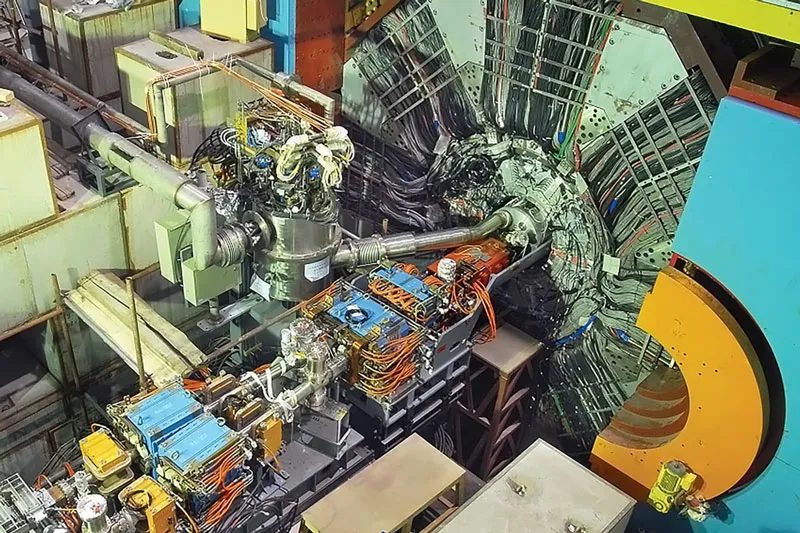
Brookhaven National Laboratory (BNL), which once developed the key superconducting magnets for Beijing's collider, is now forced to turn to China for new hardware. The Chinese Institute of High Energy Physics (IHEP) said that in May 2025 US researchers offered to purchase a combined superconducting magnet similar to the one built for the BEPCII upgrade.
The component is a complex final-focusing system installed on both sides of the electron-positron collision point. Each of the two modules combines a superconducting coil that squeezes the beam before the encounter and an anti-solenoid that cancels the field of the main BESIII detector solenoid. Development of such a magnet took 13 years, and its performance is claimed to exceed that of the US predecessor by 40%. Whether a deal was reached is not disclosed.
According to a paper released by institute specialists in July 2026, the nominal quadrupole field gradient was raised from 18.7 to 25 T/m. The winding was produced using the so-called serpentine winding technique. Tests were conducted at cryogenic temperatures of 4.2 to 4.5 K, equivalent to about −269 °C. Both magnets were installed in late 2024 and have been in active experimental use since May 2025.
The new components became a central element of the BEPCII-U collider upgrade. Stronger focusing reduces the transverse size of the colliding beams at the interaction point and thus increases the collision probability. The IHEP facility, completed back in 1988, accelerates electrons and positrons to nearly the speed of light, letting scientists test fundamental theories and search for rare phenomena.
The first major collider upgrade, finished in 2009 and giving it the BEPCII name, relied on superconducting magnets co-designed by IHEP and BNL, then manufactured and tested in the United States. However, the latest phase, started in 2021 and completed last year, was carried out entirely with Chinese technology. Now the American lab, once a leader in this field, is itself seeking to buy finished products from its Chinese counterpart.