OLED TVs Got Brighter, But Burn-In Still Haunts Them After 10,000-Hour Test
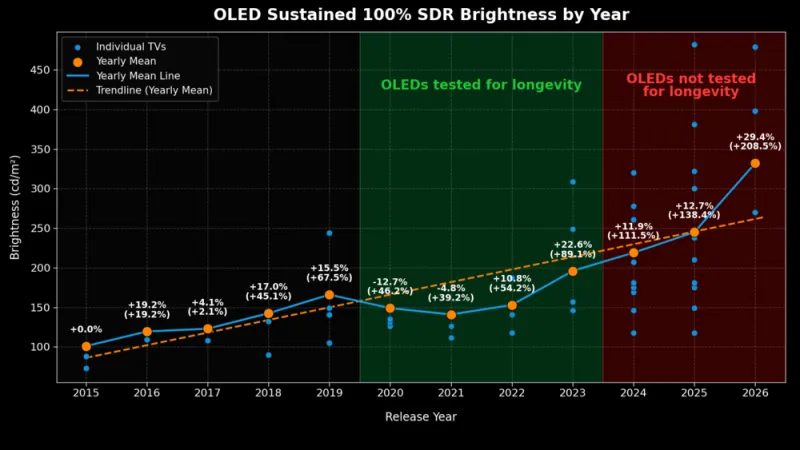
OLED displays have solved many issues inherent to LCD panels, including color accuracy, dynamic range, and power efficiency. However, in their early days, OLEDs earned a reputation for being dim, having short lifespans, and suffering from burn-in. Over time, manufacturers developed better organic dyes and introduced burn-in prevention techniques, making OLED longevity much closer to that of LCDs.
A recent comparison of OLED TVs conducted by RTings reveals that between 2017 and 2023, there has been no major breakthrough in burn-in resistance beyond brightness improvements. The dim screen problem, which previously prevented OLEDs from properly displaying HDR content, has been effectively addressed. Yet, after a stress test lasting over 10,000 hours — simulating roughly 10 years of regular use at maximum SDR brightness — static elements like the CNN news ticker burned in even on the newest models, with all burn-in prevention features enabled.
The key takeaway is that while the expected panel lifespan at full brightness remains unchanged, the higher brightness headroom allows users to extend the display's life by lowering brightness significantly. It is also essential to keep features like pixel refresh cycles active. This is underscored by Hardware Unboxed's experiments with a QD-OLED monitor, where a worst-case 6,000-hour stress test caused notable burn-in due to uneven subpixel wear. The results suggest that despite brighter panels, OLED burn-in remains a real concern for users who display static content for extended periods.