Maker builds a miniature Hammond organ from scratch — no chips, just steel and magnetism
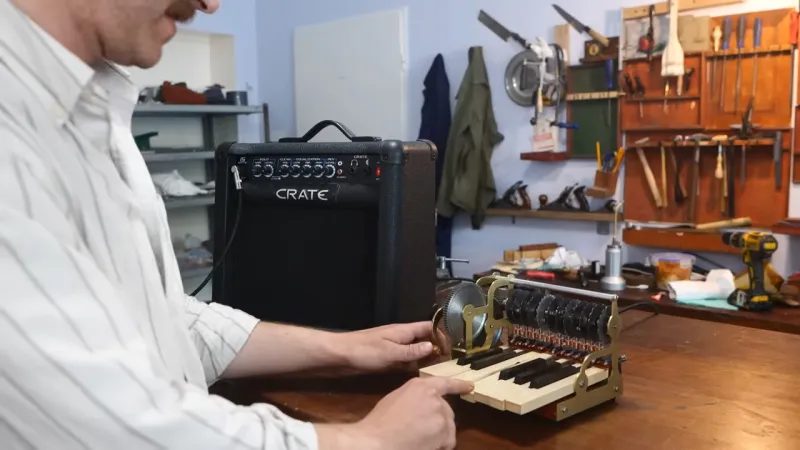
The Hammond organ is one of the earliest electromechanical musical instruments, designed to reproduce the sound of a pipe organ in a compact, piano-like form factor. Its simplicity is almost deceptive — which is exactly why decided to build one from scratch, both for a gift exchange and to demonstrate how the technology works.
Uri's version is far smaller than the original Hammond organs. It features a single hand-cranked octave and lacks the iconic spinning Leslie speaker, instead connecting to any standard guitar amplifier. Each of the twelve keys acts as a simple switch, wired to a pickup made from a coil of wire wrapped around a steel rod — similar to the magnetic pickups found in electric guitars.
The real magic lies in the tone wheels. As each wheel spins past its pickup, the ferromagnetic teeth induce a tiny electric current, just like a vibrating guitar string. The teeth are precisely spaced to produce sine waves at the exact frequencies required for each note. That's why the brass and wood parts were handcrafted with beautiful precision, but the iron tone wheels were CNC-machined for accuracy.
There are no electronics inside the instrument — no chips, no frequency doublers, no signal processors. One key corresponds to one tone wheel, and with twelve keys, there are twelve tone wheels. The sound is entirely analog, generated purely by mechanical motion and magnetic induction. The only electronic component is the external amplifier the organ is plugged into.
This build demonstrates the elegant simplicity of the original Hammond design: a purely mechanical solution to generating musical tones, relying on precise engineering rather than digital circuitry. Uri's work is a tribute to the ingenuity of early electronic instrument design and a reminder that sometimes the most straightforward approach can produce the most satisfying results.