Hobbyist triggers lightning with a rocket and wire, captures strike on video
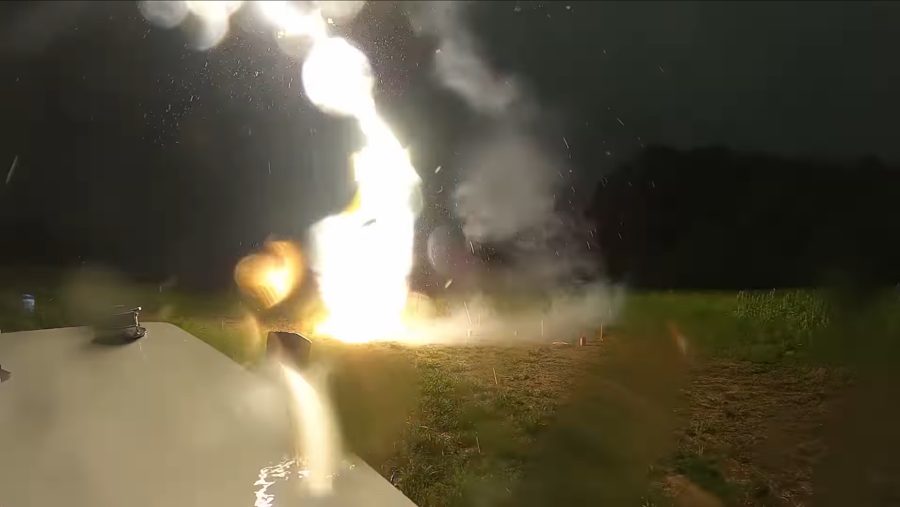
A researcher going by the name Electron Impressions has successfully triggered a lightning strike using a homemade rocket trailing a thin copper wire. After numerous attempts in stormy conditions, he not only achieved a controlled discharge but also recorded the event on video.
Lightning is hard to study because it is unpredictable, even though tall structures attract more strikes. To gain some control, scientists use small rockets carrying a wire that acts as an artificial channel for the discharge. In calm weather, the electric field near the ground is surprisingly strong at about 100 volts per meter, but during a thunderstorm it can build up to kilovolts per meter and even reverse polarity.
The charging mechanism involves updrafts carrying supercooled water, ice crystals, and graupel. The heavier graupel falls relative to the other particles and gains a negative charge when it collides with ice crystals, while the crystals become positively charged. This separates charge across the storm, with positive charge accumulating near the cloud tops and negative charge near the base. Lightning neutralizes the imbalance. In a cloud-to-ground strike, dielectric breakdown starts from both ends, with leaders rising from the ground and descending from the cloud. The wire trailed by the rocket serves as an artificial leader.
To get a reliable strike, the rocket had to be launched under a strongly negatively charged region of the cloud. Electron Impressions built his own electric field mill to measure local field strength, since commercial units are pricey. The rocket itself was 3D printed and designed for stormy flight. The thin copper wire was wound on a plastic spool engineered to minimize friction and prevent breakage. The igniter was waterproofed and triggered remotely via a walkie-talkie for safety.
After many attempts, the strike finally happened. The first discharge created a plasma channel, followed by several more strokes along the same path, indicating the cloud was negatively charged, which matched the field mill readings. Wind pushed the channel slightly sideways, and it hit a second rocket on the ground, causing it to explode. Both ignition systems were destroyed, but the primary goal of the experiment had been achieved.