Cornell cuts tantalum deposition temperature in half, boosting qubit quality factor to 16.9 million
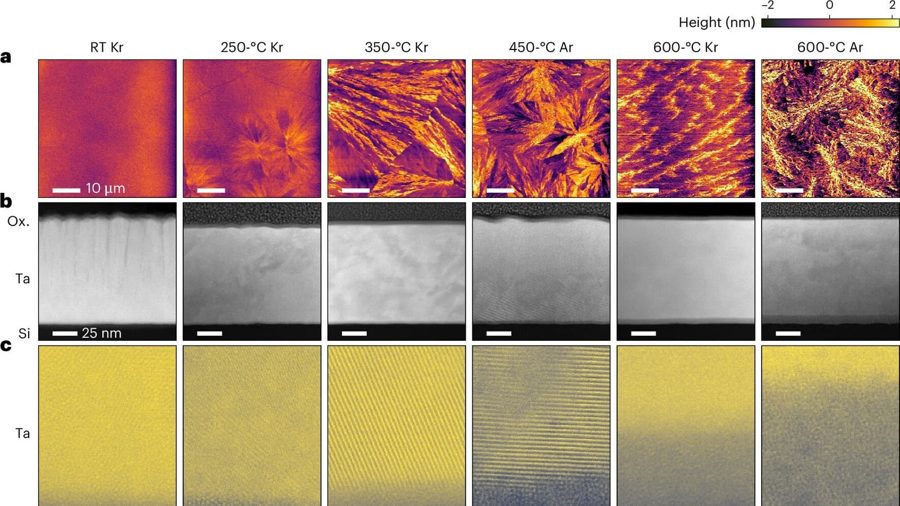
Researchers at Cornell University have developed a new method to deposit tantalum on silicon substrates at 200 °C — half the 400 °C typically required. The results were published in Nature Materials.
Tantalum has emerged as a promising material for superconducting quantum circuits, used to build qubits and microwave resonators with high performance. However, integrating it into standard semiconductor manufacturing processes has been limited by deposition temperature requirements. Conventional sputtering of tantalum onto silicon demands heating the substrate above 400 °C, which many chip fabrication lines cannot handle.
The problem lies in the material's structure. At low temperatures, tantalum forms a crystalline phase with undesirable properties, so strong heating is usually needed to obtain the desired body-centered cubic (bcc) phase. But excessive heat causes tantalum to mix with silicon, forming a thicker intermediate layer. This increases information loss and degrades the quantum circuit's performance.
The team replaced the conventional argon gas used in sputtering with krypton. This change allowed them to deposit high-quality tantalum films at 200 °C. The resulting films showed excellent electrical conductivity, and superconducting qubits made from them achieved a quality factor of up to 16.9 million.
This breakthrough paves the way for integrating tantalum into standard quantum chip manufacturing processes, potentially enabling higher-performance quantum computers with lower production costs and better compatibility with existing semiconductor fabrication lines.