ASUS RS720-E12-RS24G: Intel Xeon 6 server packs 24 NVMe drives and three GPUs in 2U
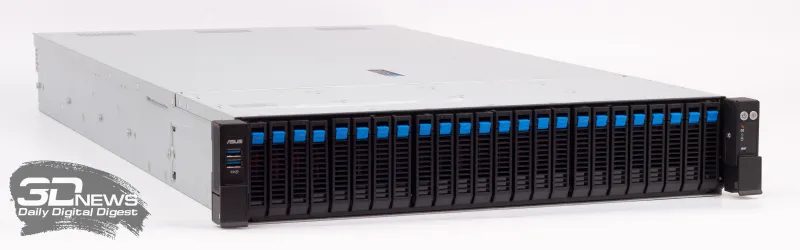
The dual-socket ASUS RS720-E12-RS24G server combines support for three full-height graphics cards, a pair of OCP NICs and 24 NVMe drives, all on PCIe 5.0 in a 2U chassis. The machine is built around current Intel Xeon 6 processors and uses the DC-MHS modular layout, which unifies the platform with the previously reviewed AMD-based model.
Externally, the RS720-E12-RS24G is nearly indistinguishable from its siblings in the lineup apart from the drive bay. The rear panel and expansion slot layout match, which makes the differences between the Intel and AMD platforms especially evident. The unit takes two Intel Xeon 6 processors on the LGA4710 socket, covering Granite Rapids-SP (6500P/6700P) or Sierra Forest-SP (6700E) parts with TDP up to 350 W. Chassis dimensions are 485 × 88 × 822 mm.
The rear panel uses a two-tier design. Two 3200 W power supplies with 80+ Titanium certification sit at the bottom on either side. Between them below are two OCP 3.0 SFF slots (PCIe 5.0 x8 and x16) plus a preinstalled DC-SCM management module ASMB12-iKVM for Intel platforms. Above the OCP slots are two PCIe 5.0 x16 slots for single-slot FHHL cards.
The upper tier holds three dual-slot FHFL cards on PCIe 5.0 x16 with a maximum TDP of 400 W each. As the risers carry two slots, pairs of x8 cards can also be installed. Lane distribution between processors is uneven: the first CPU handles the two right risers for FHFL cards, the right OCP 3.0 slot, the right FHHL slot, the DC-SCM module and four of the eight MCIO x8 ports. It also serves two internal NVMe SSDs in the M.2280 form factor.
The second processor takes over all remaining PCIe slots and MCIO connectors. Since Intel Xeon 6 processors provide no more than 88 PCIe 5.0 lanes each, PCIe switches are unavoidable for a backplane with 24 U.2 drives. The backplane also includes a pair of SlimSAS x4 ports for adding SAS/SATA storage through an external RAID/HBA controller. VROC support remains in place, so building RAID arrays from NVMe SSDs is still possible.