$22M for hollow-core fiber that cuts data latency by 30% — and a $40M hyperscaler order
Relativity Networks has secured $22 million in SAFE note funding from Rhapsody Venture Partners, Bell Ventures Inc., and Faster Than Glass LLC, among others. The company also landed a $40 million follow-on order from a major hyperscaler that chose to remain unnamed.
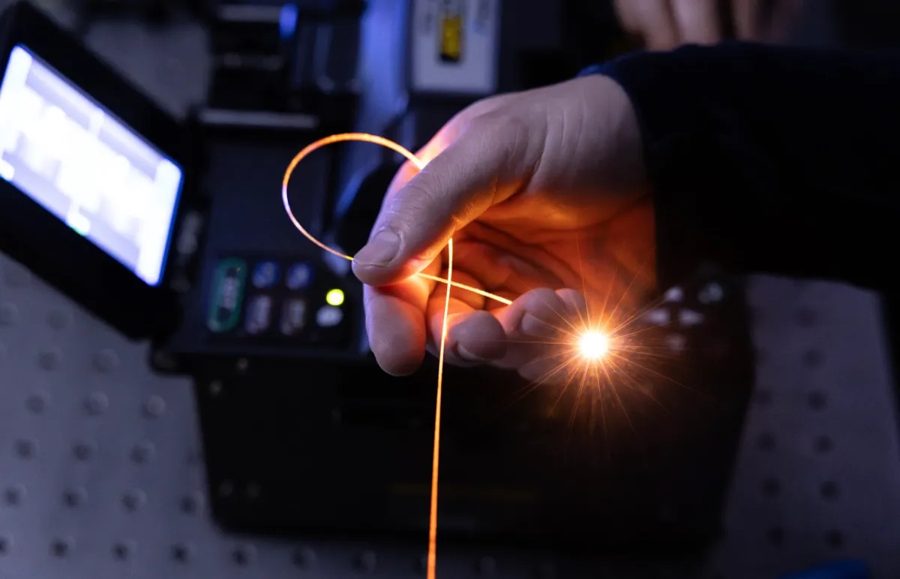
The startup is betting on hollow-core fiber, a rarely deployed technology that transmits data 30% faster than conventional fiber-optic glass. Instead of sending light through glass, hollow-core fiber channels it through a vacuum chamber inside the cable, bringing transmission speed much closer to the theoretical limit of light speed.
CEO Jason Eisenholz explains the difference in microseconds: a signal travels roughly five microseconds per kilometer in conventional fiber, but only three and a half microseconds in hollow-core fiber. While that gap may seem negligible, it becomes decisive when AI workloads span multiple GPU clusters across different data centers.
The latency problem was easy to ignore when AI compute was confined to a single rack of GPUs. But as scale grows, the time it takes for data to travel between racks, rows, and even buildings adds up quickly. Relativity Networks argues that faster fiber could change the geography of data center construction, allowing operators to place facilities farther apart without sacrificing performance.
Data center developers are expected to spend as much as $4 trillion by the end of the decade. Yet they are already heavily constrained by political and power-grid considerations in choosing locations. Hollow-core fiber could ease those constraints by making distance less of a penalty for latency-sensitive applications like AI training and inference.
The $22 million SAFE note round is a pre-seed/seed stage investment structure where the funds convert into shares at a future priced round. The $40 million hyperscaler order signals that at least one major cloud player sees value in the technology. Relativity Networks now faces the challenge of scaling production and deployment of hollow-core fiber, which has historically been difficult to manufacture at commercial volumes.
If successful, the company could offer an alternative to the conventional fiber that currently underpins global data center interconnects — and help the industry spend that $4 trillion more wisely.