These tiny robots fly using nothing but sound — no propellers needed
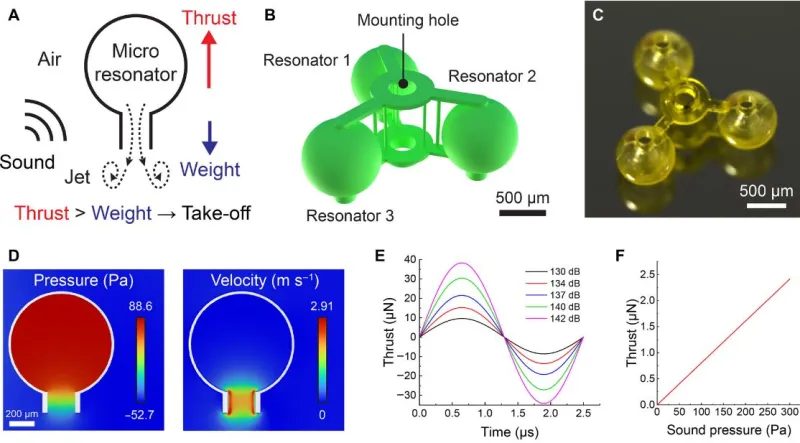
Researchers at EPFL have demonstrated a novel propulsion method for small robots that relies on the Helmholtz resonance effect — the same acoustic principle that gives musical instruments their tone. Instead of conventional motors or propellers, these devices use acoustic chambers that, when stimulated by an external sound source matching the chamber's resonance frequency, produce a jet of air at the chamber's neck.
The work, led by Junsun Hwang and published in Science Advances, showcases several proof-of-concept applications. One is a small boat equipped with three such resonance chambers, which provide both propulsion and steering control. Another is a microflier — a tiny flying robot that hovers when placed above an ultrasonic phased array. The ultrasonic waves excite the resonance chambers, generating a continuous air jet that lifts the device.
To achieve flight, the team designed microfliers with angled resonator chambers that could drive a small propeller. The thrust produced is only a fraction of a Newton, so minimizing weight was critical — the final structures weigh in the microgram range. The microfliers were fabricated using high-resolution 3D printing, and multiple iterations were tested to find the optimal chamber geometry and angle.
In the boat prototype, ultrasonic transducers were mounted directly on the bottom of each resonance chamber. For the microfliers, weight constraints forced the transducers to be external, located in the ground-based ultrasonic array. While this approach is far from practical for large-scale flying robots, it opens up a new paradigm for micro-propulsion: using sound waves instead of moving mechanical parts. The researchers note that the concept could be particularly useful for applications requiring extremely lightweight, simple, and robust micro-robots, such as environmental monitoring or exploration of confined spaces.