Radiation-blocking vest flown to the Moon and back proved as safe as Orion's shelter
Solar storms, like the one that struck in August 1972 between the Apollo 16 and Apollo 17 missions, hurl bursts of protons powerful enough to raise an astronaut's cancer risk or even trigger radiation sickness. Earth's atmosphere and magnetic field absorb this radiation, but crews heading to the Moon or Mars won't have that protection, and no spacecraft built so far carries enough shielding to stop it.
A team led by Jordan Houri and Oren Milstein of StemRad, an Israeli-American startup developing personal protective equipment against radiation, proposed a different approach: shield the astronauts themselves rather than the entire spacecraft.
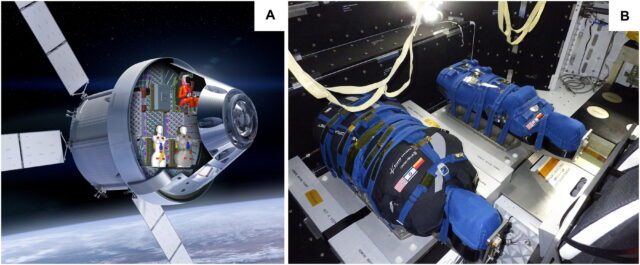
To test the concept, StemRad flew a wearable vest called AstroRad to the Moon and back aboard NASA's uncrewed Artemis I mission. Using the flight data, the team then calculated how the garment would perform during a real solar storm. The results showed the vest would protect roughly as well as the Orion capsule's heavily shielded onboard shelter, the area where the crew was meant to hide out while waiting for a storm to pass.
Spacecraft designers have spent decades weighing shielding options, from aluminum hulls to water-filled walls to superconducting magnets that would deflect charged particles before they reach the crew. All of them face the same fundamental constraint. "The question was how to use mass in a very efficient way," Milstein says. "Mass is really the bottleneck—every gram counts."
A shielding garment an astronaut could wear is at once sensible and ridiculous. The ridiculous part was that, for a long time, people thought that wearing sufficient protection was unrealistic. The test flight, the first time a radiation shield has been carried beyond low Earth orbit, proved otherwise. Individual shielding can match the performance of a heavy onboard shelter, offering a practical path for future lunar and Mars missions where every kilogram of cargo matters.
The AstroRad vest is designed to protect the most radiation-sensitive organs, including bone marrow and the torso, where blood-producing cells are concentrated. During a solar particle event, astronauts would put on the vest and continue working rather than having to retreat to a cramped shelter. The Artemis I data confirmed that the targeted approach can reduce radiation doses to critical tissues to levels comparable to those achieved by the Orion shelter, a significant finding for mission planners weighing how to protect crews on long-duration flights beyond Earth's magnetic field.