Physicists may have finally caught a glueball — a particle with no quarks at all
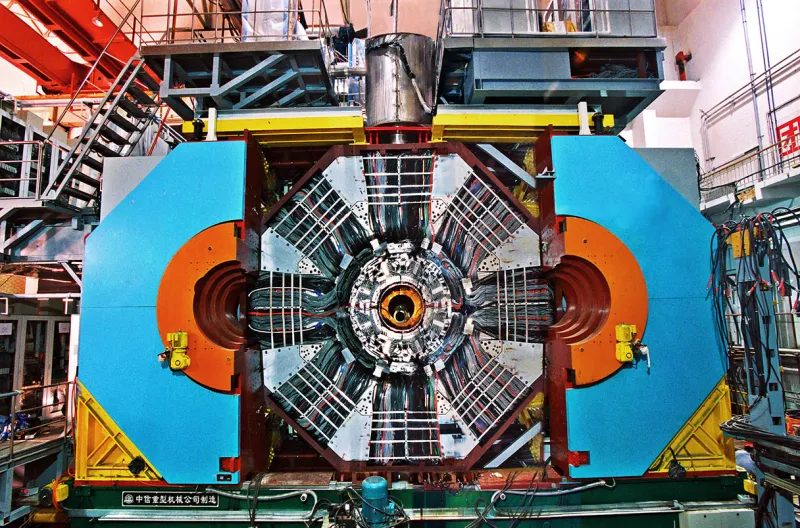
Physicists may have finally detected a glueball, an exotic particle predicted by the Standard Model but never directly observed. If confirmed, the discovery would mark one of the strangest finds in particle physics yet.
The glueball stands out among Standard Model predictions because it is not a fundamental particle, yet it contains no quarks — the building blocks of protons and neutrons — and no leptons such as electrons or muons. Instead, it is a hadron made entirely of gluons, the force-carrying particles of the strong nuclear force. It has also been called gluonium, though glueball is the name that stuck.
To picture a glueball, imagine a proton without any quarks. A proton normally contains three quarks held together by gluons. If you remove the quarks but leave enough gluons tangled together in the right configuration, you get a tangible but short-lived particle. That is the glueball: electrically neutral and decaying almost immediately into pions.
This works because gluons carry color charge — the strong force equivalent of electric charge. Color charge allows gluons to bind to one another directly, without needing quarks as intermediaries. A pure gluon-bound state is thus theoretically possible, even though it is incredibly rare.
In nature, the glueball might never appear. Even in the hottest particle collisions, a quark or two is likely to mix into the gluon soup. That is fine for researchers: what they have been searching for is the gluonic state, not necessarily a perfectly pure particle. The measured signal is consistent with a state dominated by gluon interactions.
The finding still requires verification and independent confirmation. If it holds up, it would fill a long-standing gap in the Standard Model and provide physicists with a new way to probe the strong interaction — one of the four fundamental forces of nature.