Octopus 16 EEG Headset Turns Brainwaves Into Game Controls, No Surgery Needed
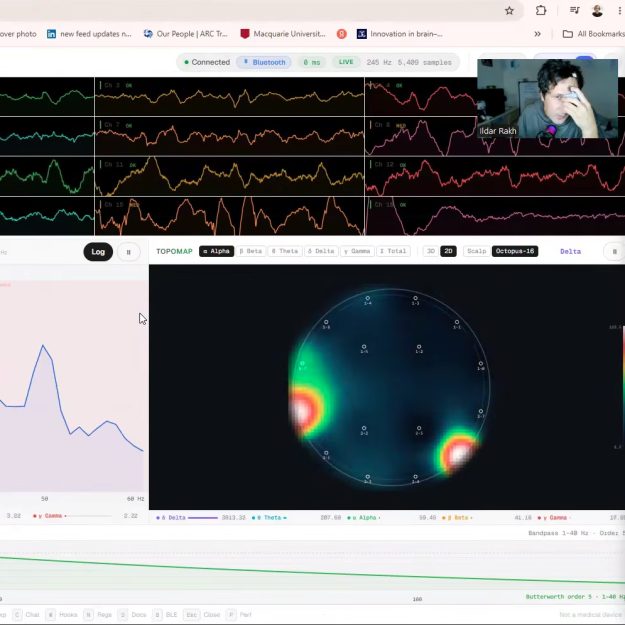
Most people still interact with computers through keyboards, mice, and touchscreens, but the idea of a direct brain-to-machine link has long captured the imagination of researchers and gamers alike. Engineers Ildar Rakhmatulin and Youssef El Abbass have been working on exactly that, developing a device aimed at using brain signals for gaming.
Their creation, dubbed Octopus 16, packs sixteen EEG electrodes into a single compact module, along with the necessary common reference and ground contacts. The electrodes themselves are spring-loaded pogo pins arranged in a cluster roughly the size of a coin. The whole assembly straps onto the head, pressing the pins against the scalp to pick up electrical activity from the brain. Data is then streamed wirelessly to a host machine over Bluetooth Low Energy.
Signal acquisition relies on a pair of Texas Instruments ADS131M08 analog-to-digital converters, each offering eight channels with 24-bit resolution. That level of precision is meant to capture fine detail in the brain's electrical patterns. An ESP32 microcontroller handles reading the ADC outputs and transmitting the data over Bluetooth.
The system is designed to work with the PiEEG software platform. In their experiments, the team demonstrated the interface by using EEG signals to detect a person's focus level, then feeding that information into simple game environments. When the user concentrated, the game responded accordingly, showing a practical use case for non-invasive brain control.
What has been shown so far is not radically different from the old Force Trainer toy, which also used EEG to detect attention. However, the Octopus 16 stands out as a more open and flexible design, potentially useful for hobbyists and researchers who want to experiment with brain-computer interfaces without spending a fortune. The use of high-resolution 24-bit ADCs could also help capture cleaner data, though the authors caution that users should verify they are getting meaningful signals rather than noise. A video demonstration is available after the break, showing the device in action.