NASA Tests Foldable Radar Antenna for Three SkyFall Mars Helicopters
Following the unexpected success of the Ingenuity Mars helicopter, NASA is advancing plans for a more ambitious mission called SkyFall. The concept involves three autonomous helicopters designed to search for resources, particularly water, on the Martian surface. To achieve this, the helicopters would need a ground-penetrating radar system, and the key challenge is fitting the antenna into the compact landing gear — a problem currently being tackled by engineers at NASA's Jet Propulsion Laboratory (JPL).
The SkyFall mission is tentatively scheduled for launch in 2028. The helicopters would be deployed from a spacecraft powered by the Space Reactor-1 fission reactor, which itself is based on components originally developed for the now-canceled Lunar Gateway space station. This reliance on a reactor and repurposed hardware introduces uncertainty about whether the mission will proceed on schedule, but it hasn't stopped JPL from working on the technical details.
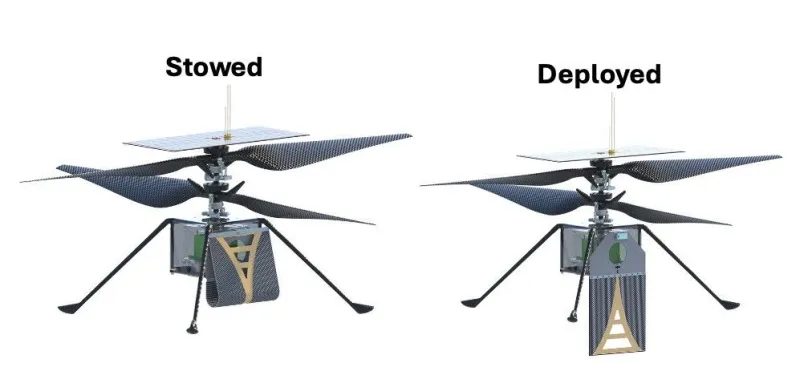
The ground-penetrating radar antenna extends beyond the helicopter's landing legs, so it must be flexible enough to fold like fabric during touchdown. The team selected an existing flexible antenna design known as Vivaldi, scaled it down for the helicopters, and tested it for durability. The prototype underwent simulated Mars landings to measure how many cycles it could withstand, as well as exposure to the extreme temperature swings between cold Martian nights and warm days.
If SkyFall launches as planned, the three helicopters could autonomously explore vast areas of the Martian surface, searching for water ice and other resources. They might even fly by the site where Ingenuity made its historic flights.