Martian paradox solved: dry ice kept ancient rivers flowing 3.6 billion years ago
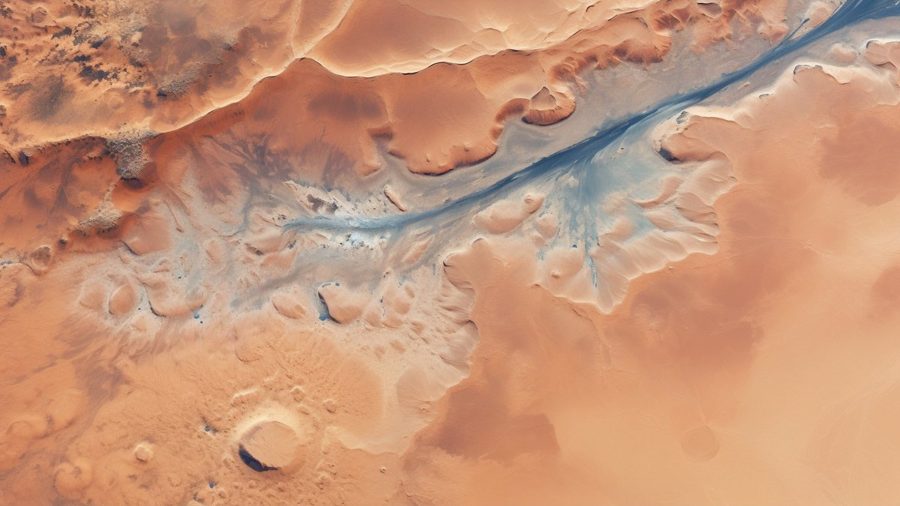
Planetary scientists have resolved a long-standing paradox in Mars' history: how could the Red Planet be covered in ice while simultaneously developing an extensive network of river valleys? A study published in the Journal of Geophysical Research: Planets offers a compelling explanation involving frozen carbon dioxide.
Around 3.6 billion years ago, Mars underwent dramatic climate shifts. Most of its surface water froze and accumulated in the southern polar ice cap. Yet, paradoxically, this same period saw the formation of numerous river valleys and channels that remain visible today. Previous theories suggested some kind of global warming event, but evidence for such warming was scarce.
The new research proposes that a shift in Mars' axial tilt caused massive amounts of atmospheric carbon dioxide to condense and freeze at the poles, forming a layer of dry ice roughly 600 meters thick. Computer modeling of this scenario revealed that the dry ice acted as an excellent thermal insulator while simultaneously exerting pressure on the multi-kilometer-thick water ice beneath it.
The combined effect of insulation and pressure caused the lower layers of water ice to melt, generating liquid water that carved river valleys and filled lakes. Crucially, the surface remained cold, preventing the water from evaporating into the thin Martian atmosphere. This created a kind of subsurface greenhouse effect without requiring a warm climate.
The model explains how liquid water could exist and shape the landscape without the need for a global warming period. The dry ice layer trapped geothermal heat and the pressure from its weight lowered the melting point of the underlying water ice, allowing it to flow and create the geological features observed by orbiters today. The study thus resolves the paradox by showing that Mars' ancient rivers were fed by melting beneath a blanket of frozen CO₂, not by a warm, wet surface environment.