Hubble reveals Milky Way merged with another galaxy 12.3 billion years ago
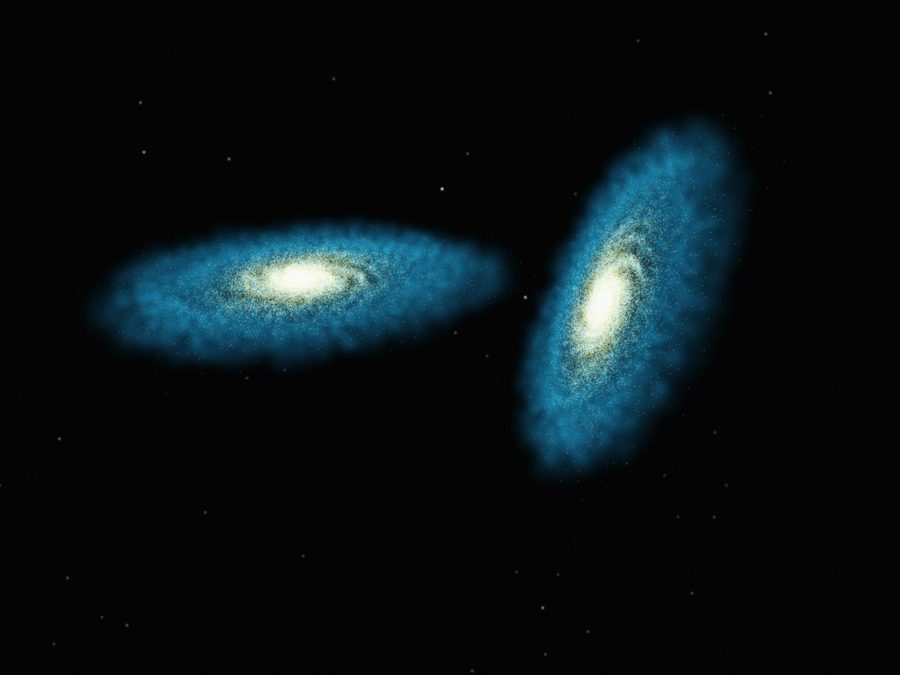
Astronomers using the Hubble Space Telescope have found evidence that the Milky Way merged with another galaxy just 1.4 billion years after the Big Bang, about 12.3 billion years ago.
Studying the early history of the Milky Way is a challenging task for astronomers. As they look farther back in time, it becomes increasingly difficult to determine what actually happened. However, thanks to Hubble's capabilities, scientists have managed to uncover a surprising fact about our galaxy. When the Milky Way was younger, it was smaller, comparable in size to other young galaxies in the universe. But its behavior was also more chaotic, and it underwent mergers with other galaxies.
To investigate this tumultuous past, the research team used Hubble to observe 39 globular clusters in the Milky Way. These clusters contain hundreds of thousands of stars each and may have different origins. In other words, some of these clusters are thought to have originated from other structures that later merged with our galaxy. Chiara Zerbinati, a co-author of the study at the University of Bologna in Italy, explained that thanks to the high resolution and depth of Hubble imaging, the team could measure the age and metal content of these clusters with unprecedented precision. Coupled with measurements from the Gaia space observatory, this made it possible to distinguish a population of globular clusters that are different from the others.
According to the results, these clusters originated from a galaxy called Low-energy-Kraken-Heracles. It had a stellar mass of about 500 million times that of the Sun. Scientists believe this merger took place about 12.3 billion years ago. While galaxy mergers are not rare events in the universe, this discovery provides a unique window into the early formation history of the Milky Way. The findings help astronomers understand how our galaxy grew and evolved through collisions with other galaxies in the early universe. The research highlights the power of combining Hubble's imaging capabilities with Gaia's precise measurements to unravel the complex past of our cosmic home.