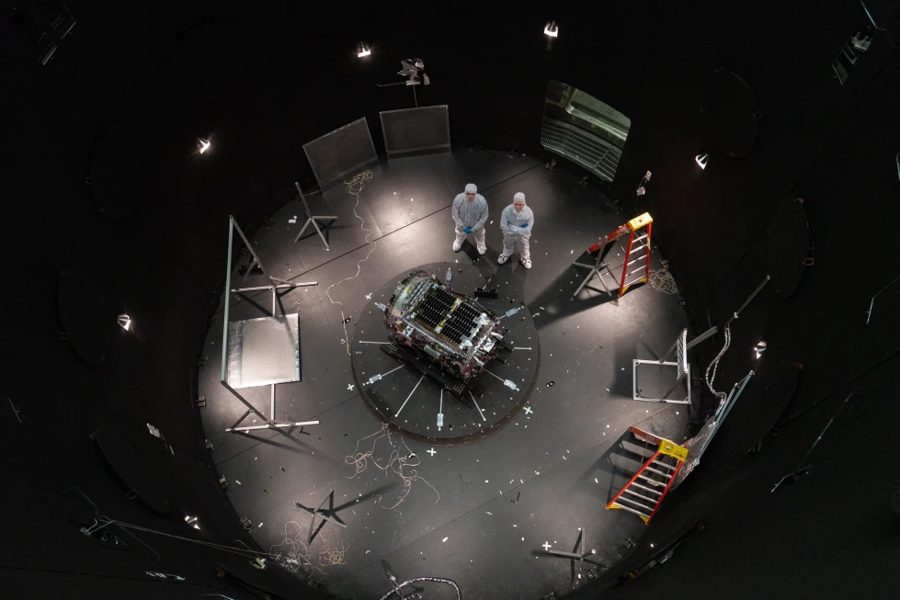
Gravitational waves may reveal 'dark stars' — the first seeds of supermassive black holes
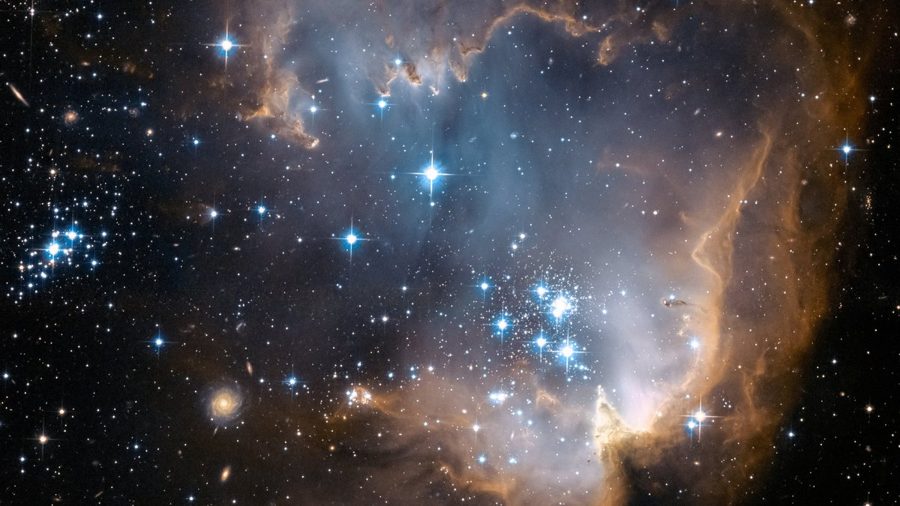
The mysterious background of ultra-low-frequency gravitational waves, detected through pulsar timing arrays (PTAs), may carry information about events that occurred more than 13 billion years ago, including the formation of the first supermassive black holes in the universe.
In a new study, researchers Sohan Hooda and Cosmin Ilie of Colgate University investigated whether supermassive black holes that formed in the early universe could have made a significant contribution to the gravitational wave background currently recorded by PTAs.
PTAs use rapidly rotating neutron stars — pulsars — as exceptionally precise cosmic clocks. Passing gravitational waves subtly alter the arrival times of radio pulses on Earth. By observing multiple pulsars over many years, scientific collaborations worldwide have detected evidence of a stochastic gravitational wave background at nanohertz frequencies.
The primary astrophysical explanation for this phenomenon is the cosmic population of merging supermassive black hole binaries with a combined mass exceeding one billion solar masses. However, this raises a key question: where did the initial "seeds" of such enormous black holes come from? Observations from the James Webb Space Telescope and the Chandra X-ray Observatory have revealed massive black holes surprisingly early in cosmic history, intensifying interest in alternative formation scenarios.
Hooda and Ilie's modeling shows that if black holes originated from the collapse of so-called dark stars — hypothetical objects powered by dark matter annihilation — their mergers in the early universe could have produced a gravitational wave signal detectable by modern PTAs. Dark stars could have reached masses of millions of suns and existed only briefly, but their collapse would have formed massive black holes. These black holes would then merge, generating gravitational waves that, stretched over billions of years, became part of the background observed today.
The researchers emphasize that their model does not require exotic physics but uses well-known mechanisms within standard cosmology. If future PTA observations confirm the characteristic signatures of such a signal, it would provide indirect evidence for the existence of dark stars and explain the origin of the very first supermassive black holes. The study is published in the journal Physical Review D.