Diamonds float in their own melt: physicists discover anomaly at 1.8 terapascals
An international team of physicists led by Marius Millot from Lawrence Livermore National Laboratory has conducted experiments on the OMEGA laser facility at the University of Rochester. Powerful laser pulses created shock waves in microscopic diamond samples, ramping up pressure from 600 gigapascals to 1.8 terapascals. The temperature during these experiments exceeded the surface temperature of the Sun. In each run, researchers simultaneously measured shock velocity, temperature, and reflectivity of the sample, while X-ray imaging captured changes in crystal structure in real time.
The first surprise was that the melting point turned out to be lower than previously assumed. Diamond transitioned into a liquid state at 7,300 kelvins and a pressure of about 1 terapascal — roughly a thousand degrees less than earlier estimates had indicated. The second surprise involved the crystal lattice. Up to the very moment of melting, diamond retained its familiar cubic structure, even though theorists had predicted the emergence of a special BC8 phase — a body-centered cubic form of carbon. This phase never appeared.
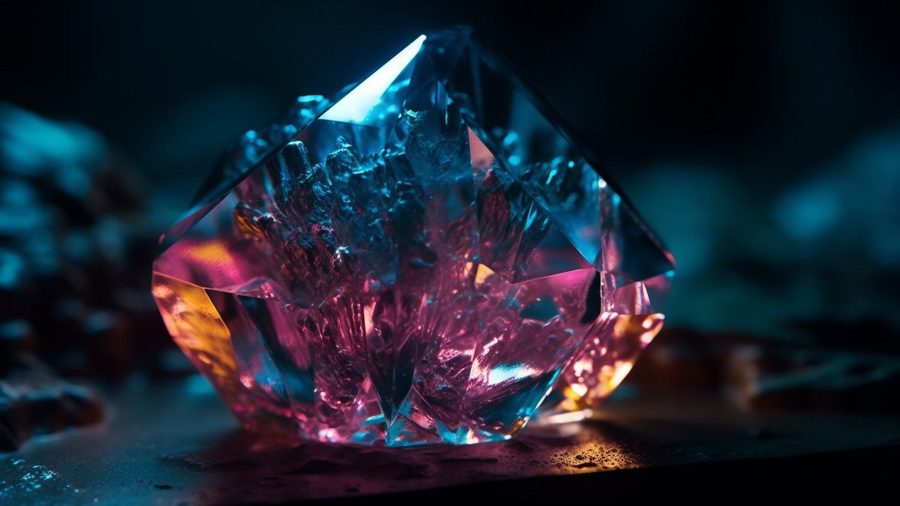
The most unexpected finding concerned density differences. The scientists discovered that solid diamond has a lower density than liquid carbon under the same conditions. This means that solid diamond literally floats in its own melt, much like ice floats in water. Such behavior has never been observed for carbon before and is explained by the fact that at high pressures, atoms in the liquid pack more densely than in the crystal lattice.
These results are important for understanding the internal structure of giant planets and exoplanets, where carbon is present in enormous quantities. In the depths of such worlds, entire oceans of liquid carbon may exist, in which diamond icebergs float. The findings also challenge existing models of carbon phase transitions and may lead to revisions in planetary formation theories. The research was published in the journal Nature Physics.