Astronomers spot vacuum bending light for the first time — confirming Heisenberg's 90-year-old prediction
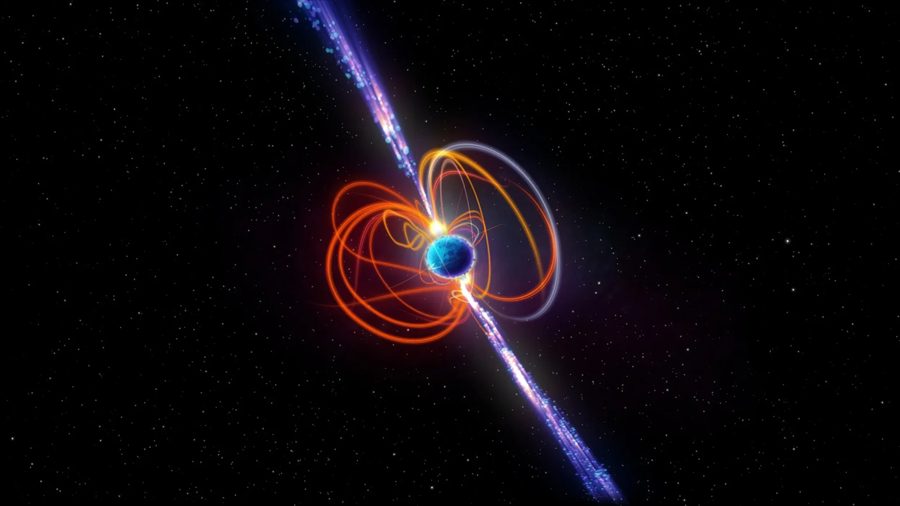
Australian researchers may have detected vacuum birefringence for the first time — a quantum effect predicted by Werner Heisenberg nearly 90 years ago. Observations of magnetar 1E1547 suggest that even empty space can alter the polarization of light passing through an extremely strong magnetic field.
Heisenberg, who won the Nobel Prize in Physics in 1932, proposed that a vacuum is not truly empty: it constantly teems with so-called virtual particles that briefly appear and vanish. In the presence of a powerful magnetic field, these particles should make light behave in unusual ways, notably splitting it into two rays traveling at different speeds — a phenomenon known as birefringence.
Detecting this effect under ordinary conditions is impossible, as it requires fields found only around magnetars, a rare type of neutron star with the strongest magnetic fields in the universe. The team, including Dr. Marcus Lower from Swinburne University of Technology, used magnetar 1E1547 as a natural test bed to put the theoretical prediction to the test.
The findings were published in the journal Nature on August 5. The authors say the data may represent the first observational evidence of vacuum birefringence in a magnetar's ultra-strong magnetic field. Still, they caution that the result needs further verification: the effect is extremely faint, and alternative explanations for the signal cannot yet be ruled out.
If confirmed, the discovery would open a new window into the quantum nature of space and allow scientists to probe matter under conditions unattainable in terrestrial laboratories. Magnetars would then serve as natural laboratories for fundamental physics, bringing Heisenberg's century-old hypothesis into the realm of observationally confirmed science.