Largest 2D Map of the Universe Released: 5.6 Trillion Pixels, 4 Billion Objects
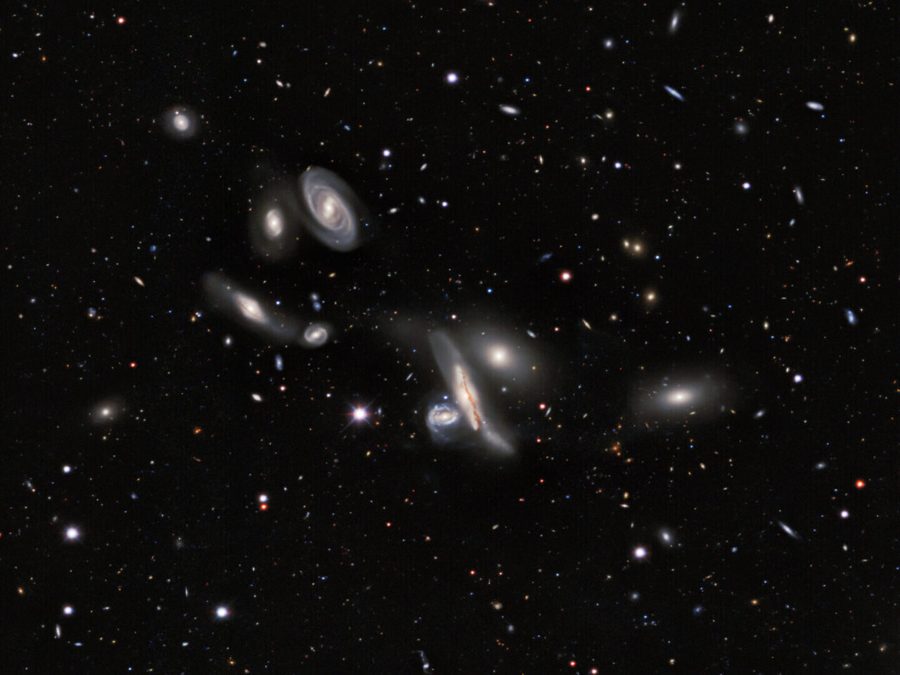
Astronomers have completed the largest two-dimensional map of the universe ever assembled, capping a 13-year effort to catalog the cosmos in unprecedented detail. The project, carried out by the Dark Energy Spectroscopic Instrument (DESI) Legacy Imaging Surveys team, combines more than 263,000 telescope exposures collected over more than a decade in visible and near-infrared wavelengths. The result is a mosaic of 5.6 trillion pixels covering roughly three-quarters of the sky and capturing nearly 4 billion celestial objects, including stars, galaxies, and other cosmic phenomena.
The map draws on observations from multiple ground-based telescopes, with data processing and curation supported by the U.S. National Science Foundation's NOIRLab. According to the team, the survey provides a sweeping new view of the universe and is already becoming an essential tool for researchers. David Schlegel, co-lead of the Legacy Surveys and a scientist at the U.S. Department of Energy's Lawrence Berkeley National Laboratory, noted that astronomers routinely pull up the Legacy Imaging Viewer as a first step when examining a new object of interest.
The dataset spans a wide range of cosmic scales, from individual stars within our own galaxy to distant galaxies billions of light-years away. The survey's depth and breadth are expected to support a broad array of future research, including studies of galaxy evolution, large-scale structure, and the search for rare or transient astronomical events. The release marks a milestone in observational astronomy, offering a publicly accessible reference that researchers can use for years to come. The project builds on earlier sky surveys but significantly expands both resolution and sky coverage, setting a new standard for wide-field astronomical imaging.