Korean scientists found a way to stamp invisible AR/VR lenses — and kill color distortion
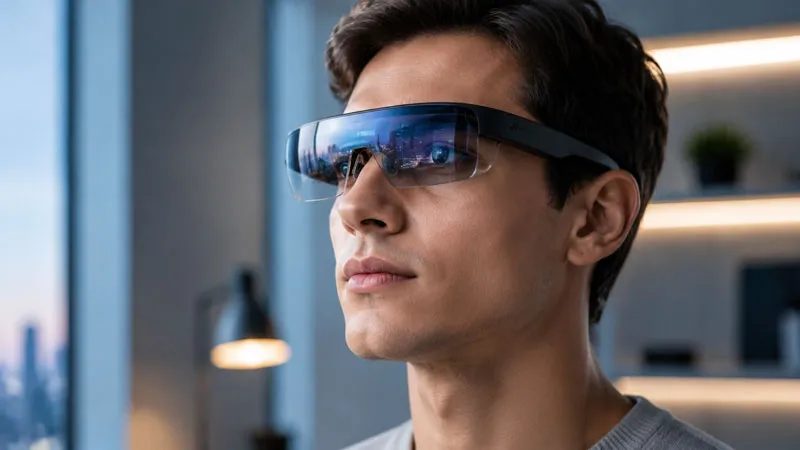
Researchers from Pohang University of Science and Technology (POSTECH) in South Korea have announced a breakthrough in metalens technology — ultra-thin optical elements that could replace bulky lens systems in augmented and virtual reality devices. They tackled two key barriers to mass adoption: eliminating chromatic aberrations for full-color imaging and developing a scalable manufacturing method.
Unlike conventional glass lenses that rely on curved surfaces to bend light, metalenses use a flat metasurface covered with millions of nanostructures — typically tiny pillars. These elements, smaller than the wavelength of light, alter the phase, amplitude, and direction of photons, forming an image in an extremely thin material layer. This means thick stacks of lenses in AR/VR glasses could be replaced by flat, lightweight plates. However, the main challenge remained chromatic aberration: red, green, and blue light focused at different distances due to the properties of materials and nanostructures, causing color fringing.
For mass production, it is crucial that the entire metalens array is made from a single material — this keeps costs low and simplifies the process. Traditionally, engineers tuned the width of nanopillars individually for each color, but this resulted in different focal points for red, green, and blue light, producing color artifacts instead of a sharp full-color image. The POSTECH team took a different approach: they used nanostructures of uniform height but varied the spacing between them. This allowed all colors to focus at the same distance while using only one material.
Beyond solving the color issue, the researchers also developed a method for mass-producing these metalenses using nanoimprint lithography — a process similar to stamping. This technique enables high-volume, low-cost manufacturing of thin, lightweight lenses that are nearly invisible and weightless to the user. The breakthrough could accelerate the development of next-generation AR/VR headsets that are more comfortable and visually accurate, removing the need for bulky corrective optics while delivering crisp, full-color imagery.