China launches Guowang satellites just days after Long March 7A failure — and a UAE payload too
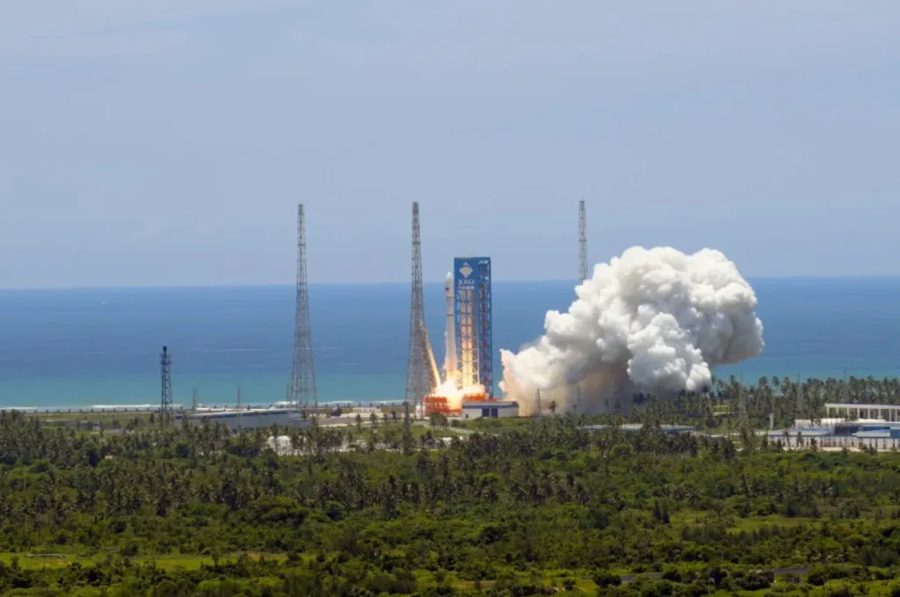
China conducted two launches over the weekend: one carrying a new batch of satellites for the Guowang megaconstellation, and another delivering an experimental satellite for the United Arab Emirates. The Long March 12 mission lifted off less than a week after the explosive failure of a Long March 7A rocket, indicating that the problem was not related to the YF-100 engine family. Had the issue been with those engines, the consequences could have cascaded across major Chinese space programs.
The Long March 12 launched at 12:10 a.m. Eastern (0410 UTC) on August 16 from pad 2 at the Hainan commercial space launch center in southern China. The China Aerospace Science and Technology Corporation (CASC) confirmed the mission was a success, announcing that the payload was a new batch of satellites for the Guowang constellation. This is the 24th operational batch launched for the program, bringing the total number of satellites in orbit to 195, not counting related experimental satellites. The satellites were built by CASC's China Academy of Space Technology (CAST). In keeping with the program's typical secrecy, no details or images of the satellites were released. The Guowang program aims to deploy approximately 13,000 satellites in low Earth orbit.
The launch was operated by CASC's China Commercial Rocket division, which uses the acronym CACL. This entity should not be confused with another commercially focused CASC unit, China Rocket Co., which operates the Jielong solid rocket series.
This mission was the seventh flight of the standard, expendable Long March 12 variant. CASC is also developing the potentially reusable Long March 12A, which uses methane-liquid oxygen propulsion, as well as a kerosene-liquid oxygen version.
In a separate launch on August 17, a Long March 2C rocket lifted off from the Xichang Satellite Launch Center carrying a satellite for the UAE. The payload, designated as a developmental satellite, was built by China's DFH Satellite Co. for the UAE's space agency. The mission was conducted under a commercial contract, highlighting China's growing role in providing launch services for international customers. The Long March 2C is a reliable workhorse rocket that has been in service for decades, with this launch marking its 80th flight overall.