Astronomers found a 'Mega-Earth' 23 times heavier than ours — and it defies planet formation models
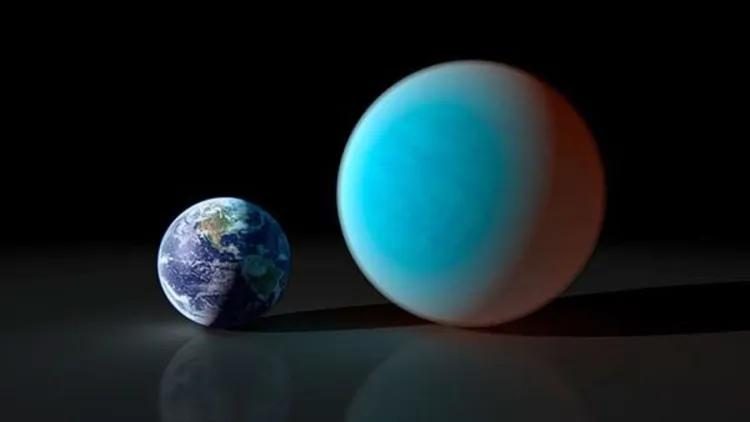
Astronomers have discovered an unusual exoplanet, GJ 523b, that challenges existing theories of planetary formation. With a radius just 2.55 times that of Earth, its mass is approximately 23.5 Earth masses, and its average density reaches 7.74 g/cm³ — significantly higher than Earth's 5.51 g/cm³. This suggests the planet is composed mostly of heavy materials with only a thin gaseous envelope.
GJ 523b belongs to the rare category of "Mega-Earths" — exceptionally massive planets with a predominantly rocky composition. According to standard models, such a massive core should have continued to accumulate gas and eventually become a gas giant like Jupiter or Saturn. Instead, GJ 523b stopped growing, retaining a dense solid core.
The planet was initially detected by NASA's TESS space telescope. Follow-up observations were conducted using the 3.5-meter WIYN telescope at Kitt Peak National Observatory in Arizona. Spectroscopic measurements allowed scientists to determine how strongly GJ 523b gravitationally influences its host star, and from that, calculate its mass precisely.
GJ 523b completes an orbit around its star every 17.75 days. Another key feature of the system is its young age — estimated at about 170 million years, which is very young by cosmic standards. The combination of youth and extreme mass makes this discovery particularly valuable for science. Standard models predict that as a rocky-metallic core grows, it begins to actively attract gas from the surrounding protoplanetary disk. GJ 523b, for reasons still unknown, did not follow this path.
The discovery may force a revision of current theories about how planetary systems form and evolve. Researchers are now planning further observations to understand the composition and history of this mysterious world.